EPC (RPC stack for Emacs Lisp) for Python
Links:
- Documentation (at Read the Docs)
- Repository (at GitHub)
- Issue tracker (at GitHub)
- PyPI
- Travis CI

Other resources:
- kiwanami/emacs-epc (Client and server implementation in Emacs Lisp and Perl.)
- tkf/emacs-jedi (Python completion for Emacs using EPC server.)
What is this?
EPC is an RPC stack for Emacs Lisp and Python-EPC is its server side and client side implementation in Python. Using Python-EPC, you can easily call Emacs Lisp functions from Python and Python functions from Emacs. For example, you can use Python GUI module to build widgets for Emacs (see examples/gtk/server.py for example).
Python-EPC is tested against Python 2.6, 2.7, 3.2 and 3.3.
Install
To install Python-EPC and its dependency sexpdata, run the following command.:
pip install epc
Usage
Save the following code as my-server.py.
(You can find functionally the same code in examples/echo/server.py):
from epc.server import EPCServer

server = EPCServer(('localhost', 0))

@server.register_function
def echo(*a):
    return a

server.print_port()
server.serve_forever()
And then run the following code from Emacs. This is a stripped version of examples/echo/client.el included in Python-EPC repository.:
(require 'epc)

(defvar my-epc (epc:start-epc "python" '("my-server.py")))

(deferred:$
  (epc:call-deferred my-epc 'echo '(10))
  (deferred:nextc it
    (lambda (x) (message "Return : %S" x))))

(message "Return : %S" (epc:call-sync my-epc 'echo '(10 40)))
If you have carton installed, you can run the above sample by simply typing the following commands:
make elpa        # install EPC in a separated environment
make run-sample  # run examples/echo/client.el
For example of bidirectional communication and integration with GTK, see examples/gtk/server.py. You can run this example by:
make elpa
make run-gtk-sample  # run examples/gtk/client.el
License
Python-EPC is licensed under GPL v3. See COPYING for details.
EPC server API
Server
-
class
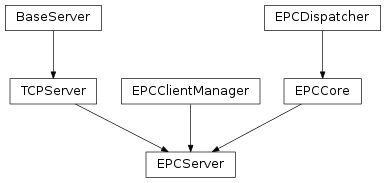
epc.server.EPCServer(server_address, RequestHandlerClass=<class epc.handler.EPCHandler>, bind_and_activate=True, debugger=None, log_traceback=False)¶ A server class to publish functions and call functions via EPC protocol.
To publish Python functions, all you need is
register_function(),print_port()andserve_forever().>>> server = EPCServer(('localhost', 0)) >>> def echo(*a): ... return a >>> server.register_function(echo) #doctest: +ELLIPSIS <function echo at 0x...> >>> server.print_port() #doctest: +SKIP 9999 >>> server.serve_forever() #doctest: +SKIP
To call client’s method, use
clientsattribute to get client handler and use itsEPCHandler.call()andEPCHandler.methods()methods to communicate with connected client.>>> handler = server.clients[0] #doctest: +SKIP >>> def callback(reply): ... print(reply) >>> handler.call('method_name', ['arg-1', 'arg-2', 'arg-3'], ... callback) #doctest: +SKIP
See
SocketServer.TCPServerandSocketServer.BaseServerfor other usable methods.-
register_function(function, name=None)¶ Register function to be called from EPC client.
Parameters: - function (callable) – Function to publish.
- name (str) – Name by which function is published.
This method returns the given function as-is, so that you can use it as a decorator.
-
register_instance(instance, allow_dotted_names=False)¶ Register an instance to respond to EPC requests.
Parameters: - instance (object) – An object with methods to provide to peer. If this instance has _get_method method, EPC method name resolution can be done by this method.
- allow_dotted_names (bool) – If it is true, method names containing dots are supported. They are resolved using getattr for each part of the name as long as it does not start with ‘_’.
Unlike
register_function(), only one instance can be registered.
-
set_debugger(debugger)¶ Set debugger to run when an error occurs in published method.
You can also set debugger by passing debugger argument to the class constructor.
Parameters: debugger ({'pdb', 'ipdb', None}) – type of debugger.
-
print_port(stream=<open file '<stdout>', mode 'w'>)¶ Print port this EPC server runs on.
As Emacs client reads port number from STDOUT, you need to call this just before calling
serve_forever().Parameters: stream (text stream) – A stream object to write port on. Default is sys.stdout.
-
clients= []¶ A list of
EPCHandlerobject for connected clients.
-
handle_client_connect(handler)¶ Handler which is called with a newly connected client.
Parameters: handler ( EPCHandler) – Object for handling request from the client.Default implementation does nothing.
-
handle_client_disconnect(handler)¶ Handler which is called with a disconnected client.
Parameters: handler ( EPCHandler) – Object for handling request from the client.Default implementation does nothing.
-
-
class
epc.server.ThreadingEPCServer(*args, **kwds)¶ Class
EPCServermixed withSocketServer.ThreadingMixIn.Use this class when combining EPCServer with other Python module which has event loop, such as GUI modules. For example, see examples/gtk/server.py for how to use this class with GTK
Handler
-
class
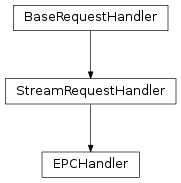
epc.server.EPCHandler(request, client_address, server)¶ -
handle_error(err)¶ Handle error which is not handled by errback.
Parameters: err (Exception) – An error not handled by other mechanisms. Return type: boolean Return True from this function means that error is properly handled, so the error is not sent to client. Do not confuse this with
SocketServer.BaseServer.handle_error(). This method is for handling error for each client, not for entire server. Default implementation logs the error and returns True if the error is coming from remote [1] or returns False otherwise. Therefore, only the error occurs in this handler class is sent to remote.[1] More specifically, it returns True if err is an instance of BaseRemoteErrororEPCClosed.
-
call(name, *args, **kwds)¶ Call method connected to this handler.
Parameters: - name (str) – Method name to call.
- args (list) – Arguments for remote method to call.
- callback (callable) – A function to be called with returned value of the remote method.
- errback (callable) – A function to be called with an error occurred
in the remote method. It is either an instance
of
ReturnErrororEPCError.
-
methods(*args, **kwds)¶ Request info of callable remote methods.
Arguments for
call()except for name can be applied to this function too.
-
call_sync(name, args, timeout=None)¶ Blocking version of
call().Parameters: If the called remote function raise an exception, this method raise an exception. If you give timeout, this method may raise an Empty exception.
-
methods_sync(timeout=None)¶ Blocking version of
methods(). See alsocall_sync().
-
EPC client API
-
class
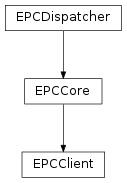
epc.client.EPCClient(socket_or_address=None, debugger=None, log_traceback=False)¶ EPC client class to call remote functions and serve Python functions.
>>> client = EPCClient()
>>> client.connect(('localhost', 9999))                 #doctest: +SKIP
>>> client.call_sync('echo', [111, 222, 333])           #doctest: +SKIP
[111, 222, 333]
To serve Python functions, you can use
register_function().>>> client.register_function(str.upper) <method 'upper' of 'str' objects>
register_function()can be used as a decorator.>>> @client.register_function ... def add(x, y): ... return x + y
Also, you can initialize client and connect to the server by one line.
>>> client = EPCClient(('localhost', 9999)) #doctest: +SKIP
-
call()¶ Alias of
epc.server.EPCHandler.call().
-
call_sync()¶ Alias of
epc.server.EPCHandler.call_sync().
-
methods()¶ Alias of
epc.server.EPCHandler.methods().
-
methods_sync()¶ Alias of
epc.server.EPCHandler.methods_sync().
-
connect(socket_or_address)¶ Connect to server and start serving registered functions.
Parameters: socket_or_address (tuple or socket object) – A (host, port)pair to be passed to socket.create_connection, or a socket object.
-
close()¶ Close connection.
-
EPC exceptions
-
class
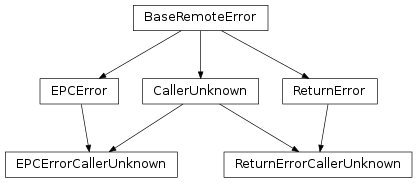
epc.handler.BaseRemoteError¶ All exceptions from remote method are derived from this class.
-
class
epc.handler.CallerUnknown¶ Error raised in remote method, but caller of the method is unknown.
-
class
epc.handler.EPCError¶ Error returned by epc-error protocol.
-
class
epc.handler.ReturnError¶ Error returned by return-error protocol.
-
class
epc.handler.ReturnErrorCallerUnknown¶ Same as
ReturnError, but caller is unknown.